
Respect
Knowledge is shared through trust and relationship.
Documentation as Pedagogy
Some of India's most sophisticated engineering, agricultural and ecological science was never written down. We document it before it disappears.
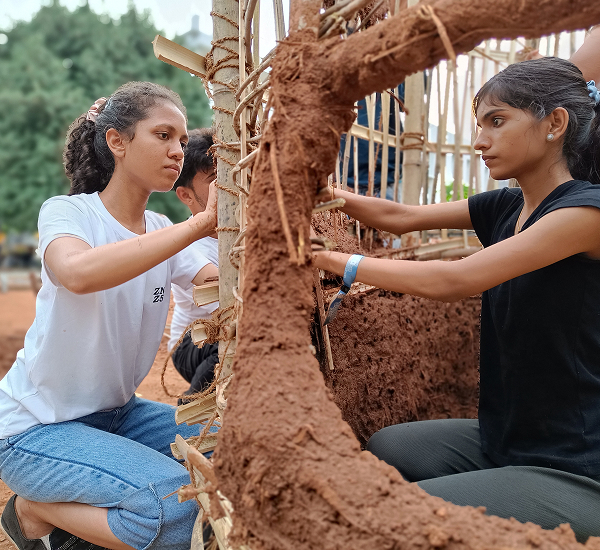
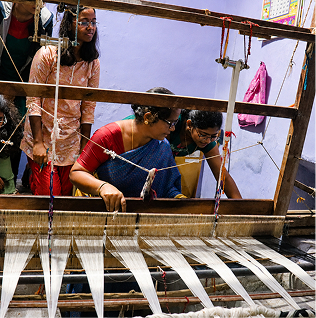
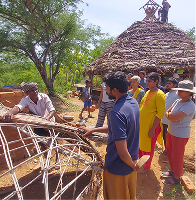
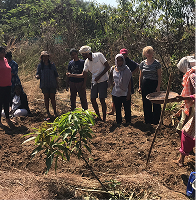
FIEK's research approach is built on direct, extended engagement with communities whose livelihoods are inseparable from their environment farming, home-building, craft, and oral tradition, developed in close relationship with local forests, soils and water systems. We have worked with the Konda Reddi of the Godavari region, the Chenchu of Nallamala, the potters and bamboo artisans of Indrana in Jabalpur, and the Ikkat weavers' homes of Siripuram, Telangana, among others.
This is not preservation for its own sake. Documented correctly, this knowledge answers present-day problems: climate-resilient construction, low-input farming, sustainable material sourcing as directly as it answered them a century ago.
FIEK's educational programmes are inseparable from our research practice. Our documentation is not archival nostalgia. It is active knowledge preservation that feeds contemporary education and sustainable design.
Why Indigenous Knowledge Matters Today
The environmental challenges of our time demand new ways of thinking. Yet many of the practices now recognised as sustainable have long been part of the lived knowledge of communities across India. Traditional farming systems have maintained soil fertility through ecological relationships. Vernacular architecture has responded to climate using locally available materials.
Artisan traditions have demonstrated resource efficiency, craftsmanship and circular use of materials. Community knowledge has shaped water management, biodiversity conservation and seasonal adaptation over generations. These practices are valuable not because they are old, but because they continue to offer insights into resilient ways of living.
At the same time, much of this knowledge is at risk of being lost as landscapes change, traditional livelihoods decline and opportunities for intergenerational learning diminish. Documenting and engaging with these living knowledge systems is therefore not only an act of preservation but also an investment in future learning and innovation.
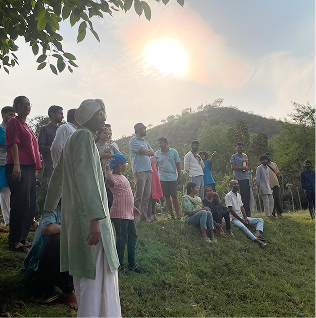
We believe meaningful research begins with listening. Our approach is collaborative rather than extractive. Communities are not viewed as subjects of study but as knowledge partners. Field research is built on long-term relationships, mutual respect and shared learning.
Rather than collecting information in isolation, we work alongside practitioners to understand ecological knowledge within the contexts where it is created, practised and transmitted. This approach allows research to remain grounded in lived experience while contributing to education, documentation and future collaboration.
Knowledge is shared through trust and relationship.

Communities actively shape the research process.

Knowledge is carefully recorded and contextualised.

Research becomes educational resources, learning experiences and opportunities for wider dialogue.
FIEK has documented vernacular architecture across multiple regions and communities around, thatched settlements of the Chenchu along Nallamala's jungle streams; the bamboo-and-timber homes of the Gutta Koya at Kunavaram; the tiny woven Nelagudise shelters of the Yaanaadulu near Nellore and Tirupati; and week-long documentation projects in Indrana, Jabalpur, mapping how artisan families' homes adapt to daily and seasonal needs.
Our approach centres the artisans themselves as the primary source, not secondary literature. Documentation happens through direct observation, apprenticeship-style learning, and recorded interviews with practising builders.
Traditional farming systems, seed sovereignty practices, and seasonal knowledge. Current focus: Konda Reddi Podu cultivation, natural pest management, and heirloom seed preservation.
Among FIEK's documentation projects, the Gummi, a traditional granary structure used across Telangana and Andhra Pradesh, illustrates how localised this knowledge really is. Communities like the Yerukala weave Gummis from wild date-palm stems; near Nagarjuna Sagar, artisans instead use the stems of Guubadadi (Indian screw tree) for the same purpose. Same function, entirely different material logic, shaped by what each landscape actually provides.
This tradition is at risk as the raw materials it depends on become scarcer. FIEK's documentation carried out with artisans including Venkataiah of the Erukala community has been shared on platforms including the National Permaculture Convergence (NPC 2023).
Academic Partnerships
FIEK has signed a Memorandum of Understanding with the Rural Development Centre, IIT Hyderabad, to jointly develop programmes bridging academic research with field-based ecological practice.
The partnership focuses on experiential learning, regenerative agriculture, indigenous ecological knowledge, sustainable architecture, and community-centred sustainability education — including pilot programmes in schools and communities covering nutritional kitchen gardens, agriculture courses, and research-driven initiatives that pair traditional knowledge with scientific inquiry.
FIEK contributes field implementation, curriculum design and community engagement; IIT Hyderabad contributes academic leadership and interdisciplinary research support. Together, the partnership aims to build scalable models for education and sustainable rural development.
Long-form accounts from FIEK's documentation work read the stories behind the research. Suggested initial entries (drawn directly from existing material, ready to publish as individual posts) Selected documentation stories, research briefs, and field reflections.
the Ikkat weaving villages of Siripuram and Ramannapeta, Telangana.
Chenchu shelters in the Nallamala Forest.
the Konda Reddi and the Mango Festival at Kotaru Gommu
The New but Old Homes, Kunavaram
the seed-storage tradition of Telangana and Andhra Pradesh
Heritage of Indrana, the Jeevika Ashram documentation gathering
Clay, Craft and the Knowledge of Making
The Life and Craft of Yesupadam, Master Thatcher of the Krishna Delta