
Farm Design & On-Site Execution
Custom designs based on sector analysis, soil assessment, and water mapping. Implementation mimics natural ecosystem patterns rather than imposing industrial models.

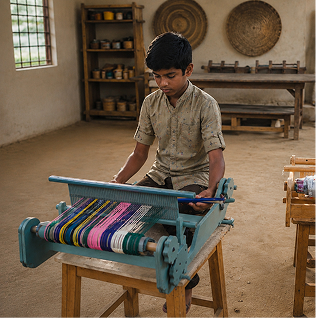
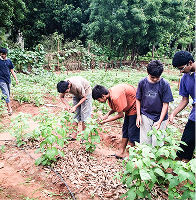
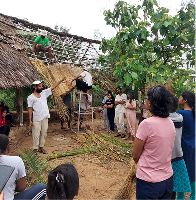
Learning Across Living Systems
FIEK's work spans three interconnected practices. Each feeds directly into the others: our field research shapes our school curriculum, our building practice trains the artisans we document, and our land restoration is itself a research site. And the questions students ask send us back to the field with sharper eyes.
Infographic: Interlocking circles or a three-petal diagram representing Agriculture | Building | Documentation.
We treat land as a working ecosystem, not a garden to be maintained. Every farm we design balances water, soil, biodiversity and yield against each other, rather than sacrificing one for another and every restoration project is also a research site, generating direct observation of how soil and species actually recover.
Custom designs based on sector analysis, soil assessment, and water mapping. Implementation mimics natural ecosystem patterns rather than imposing industrial models.

Contour swales, bunds, trenches, and watershed systems that harvest rainwater, reduce runoff, and recharge groundwater.

Composting, mulching, green manuring, and biomass application to rebuild carbon content and water-holding capacity.

Planting diverse, locally adapted trees and understory plants to restore habitat complexity and ecosystem resilience.

Multi-layered, perennial food systems that yield throughout the year while supporting local wildlife.

Seasonal vegetable systems using native seeds, companion planting, crop rotation, and natural pest management.

Closed-loop composting and organic waste management that returns nutrients to the land.

Propagation of native and regionally adapted species for ongoing site improvement and community distribution.

Maahi Permaculture Farm, Shamirpet- 6 acres restored from chemically degraded soil. 2,500+ trees across 36 species.
We study, document, and practise indigenous building systems that use locally available materials. Our work spans design consultation, artisan collaboration, and hands-on training. Every structure is climate-responsive, materially honest, and culturally rooted.

Site-specific designs drawn from local architectural traditions, climate analysis, and available materials. We study regional typologies before proposing any intervention.

We identify and collaborate with local masons, thatchers, carpenters, and craftspeople.. Their knowledge shapes the final structure.

Hands-on capacity building in traditional techniques: cob, adobe, rammed earth, wattle and daub, lime slaking and application, bamboo joinery, and thatch layering.

Local soil analysis, stone identification, timber assessment, and sustainable harvesting protocols. We build with what the land offers.
We see traditional crafts as living systems of technical and ecological knowledge, not heritage displays. Working alongside artisans and indigenous communities, we document the materials, techniques, design principles, and ecological understanding embedded in their practices. This knowledge is not preserved as an archive alone it is translated into educational programmes, research, restoration initiatives, and contemporary applications.
Our approach is grounded in long-term relationships with the communities who continue to sustain these traditions, ensuring that knowledge is documented with context, respect, and authenticity.

Measured surveys of vernacular structures, material analysis, and construction technique documentation. Current focus: Chenchu shelters (Nallamala), Gutta Koya homes (Kunavaram), Yaanaadulu round shelters (Nellore/Tirupati), and Gummi seed banks (Nagarjuna Sagar).

Recording techniques, tools, and craft processes through photography, measured drawing, and narrative interview. Current focus: Ikkat weavers of Siripuram and Ramannapeta; bamboo and pottery artisans of Indrana, Jabalpur.
Native flora and fauna documentation, ecosystem assessment, and habitat mapping to support restoration design and conservation planning.
Workshops for students, researchers, and community members in ethnographic observation, architectural measurement, and biodiversity recording.
Seasonal calendars, seed sovereignty practices, natural pest management, and heirloom crop documentation. Current focus: Konda Reddi Podu cultivation and traditional grain storage systems.
Preserving folklore, rituals, and community memory that encode ecological relationships and land stewardship ethics.
Whether you are a landowner seeking regenerative design, an institution researching indigenous knowledge, or a professional exploring natural building, we welcome serious collaboration.