Measurable Outcomes
| Education | Ecology | Community |
|---|---|---|
| 5 partner schools with integrated programmes | 1,400+ trees planted across school restoration sites | 6+ indigenous communities documented |
| 90% kitchen self-sufficiency achieved at LVVV | 6-acre Maahi Farm: 36 native species, 20+ vegetable varieties | IIT Hyderabad academic partnership |
| Agriculture formalised as vocational subject at Oasis School | 5-acre Aksharavanam landscape restored from semi-degraded land | Artisan networks across Telangana, Andhra Pradesh, and Madhya Pradesh |
Schools We Work With
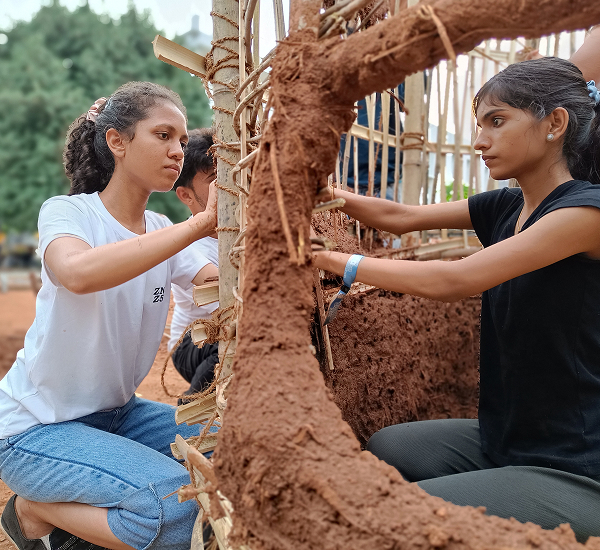

Oasis School of Excellence, Shamshabad
A CBSE school on the city’s edge. We run a Farming Immersion Program as a vocational subject. (CBSE school near Hyderabad.)
What we do:
Students get a plot. Not a demonstration bed, a real plot that will fail if they skip a week. They prepare the soil, sow, water, weed, and wait. Some lose patience and overwater. The seedlings yellow and drop. They replant. The second time, they check the soil with a finger before reaching for the can. That is the learning.
When the harvest comes, it is small. A few ladies’ fingers, some spinach, a pumpkin that took too long. The quantity is never impressive. But a child who has waited six weeks for a vegetable does not throw away the plate at lunch. That is not in the curriculum. It happens anyway.
Then the math begins. They weigh the harvest on a kitchen scale borrowed from the lab. They check vegetable prices at the local mandi: how much for brinjal, how much for spinach. They argue about pricing. One group wants to charge a premium because it is "organic." Another says nobody will buy spinach for twenty rupees when the cart outside sells it for twelve. They settle on fifteen. They do not know it, but they are learning margin, demand, and the difference between cost and value.
They set up a stall during the parent-teacher meeting. They wash the mud off the ladies’ fingers, arrange the spinach in bundles, write the prices on cardboard. Some parents buy out of sympathy. Some teachers haggle. One father asks for a discount because his son is in the program. The child says, "Sir, that is why you should pay more." The father pays full price. He tells the story in the staff room later.
The money goes back into seeds for the next cycle. It is never enough to cover everything. That is also the lesson.
In the classroom, the teachers draw the connections. The plot becomes a geometry problem: area, perimeter, spacing. The harvest becomes a data set: bar graphs of yield per bed, line graphs of growth over weeks. The market day becomes a lesson in profit and loss. The failed crop becomes a case study in variables: too much water, not enough sun, the wrong season. The science teacher talks about nitrogen. The math teacher talks about unit price. The EVS teacher talks about food miles. They are all talking about the same patch of soil.
"I thought farming was putting seeds in mud and waiting. But we had to check for worms, and the worms were good, but some were bad, and I couldn't remember which. Then we had to sell the brinjal, and I had to calculate how much to charge, and my father tried to bargain with me. I said, 'Appa, this is business now.' I think he was proud."
Venu Shiva Student, Class 10, Oasis School of Excellence
"Partnering with Mayank and his team has brought invaluable hands-on experiences in organic farming, composting, nursery development, and more. It's heartening to see our students enthusiastically learning essential skills and embracing traditional farming practices."
Junuthula Uma Devi Principal, Oasis School of Excellence
"The outdoor farming sessions are a highlight of the week... we've noticed a significant increase in teamwork, and our teachers love how the programme deepens academic understanding."
Vocational In-charge Oasis School of Excellence
Jeevana Vikasa Vidya Vanam (LVVV), Vijayawada
ICSE residential community school.
What we do:
With around 100 students and 30-40 staff on campus, Vikasa Vidya Vanam made sustainable farming a daily part of school life an hour a day, led by a student-elected "Farm Minister" and cabinet who guide their peers through cultivation. FIEK's support helped the school achieve a surplus of green leafy vegetables in a single year.
Today, students in Grades 6-10 grow over 90% of the school kitchen's vegetable requirements. The partnership extended into natural building orientation and organic household products (soaps, bio-enzymes), embedding sustainable practice into daily campus life rather than a single subject.
"Mayank's innovative thinking and exceptional facilitation has transformed our school into a model of sustainability. Our students in Grades 6–10 now produce over 90% of the kitchen's needs from our campus farm, a dream we never thought possible!"
Management LVVV School
Aksharavanam Educational Center , Kalwakurth
Alternative gurukulam-inspired school.
What we do:
Aksharavanam Educational Center in Kalwakurthy, Telangana, is a gurukulam-inspired space where learning happens by doing, alongside peers, directly from the land.
We believe meaningful education does not need four walls. Here, students absorb sustainable farming, natural building, and ecological practice by working with organic materials, raising natural structures, and learning the rhythms of the soil. To keep the campus chemical-free, they produce organic soaps and bio-enzymes understanding that sustainability is built into daily choices, not just grand ideas.
We have opened this space to young people from across the country, connecting them with artisans who share knowledge held for generations. The learning extends beyond the campus into nearby villages and the Nallamala Forest, where the Chenchu community has taught us about forest ecosystems, rural research, and resourceful living. These relationships are built slowly and respectfully and they have reshaped how we understand traditional knowledge.
Aksharavanam is not an academic programme. It is a journey into the land, into community, and into the heritage that grounds us.
FIEK designed and implemented a regenerative landscape across a five-acre, semi-degraded plot sandy-loamy soil, extreme erosion, and only around 600mm of average annual rainfall. After a full sector analysis of water, soil and land movement, the intervention centred on swales and bunds for water harvesting, followed by a diverse planting plan: 1,400 trees across 26 species, alongside biomass amendments (decomposed millet husk, groundnut shells) and green manure crops to rebuild soil fertility.
The school's peer-based, gurukulam-inspired learning model made it a natural fit for FIEK's "learning by doing" approach students, staff and volunteers worked the restoration together.
"The hands-on approach has sparked curiosity and a genuine love for nature. From planting seeds to harvesting crops, students are learning responsibility, sustainability, and the value of teamwork. Parents have shared how their children now talk about composting and gardening at home."
Madhava Reddy Secretary, Aksharavanam
Puvidham Learning Centre, Nagarkooda
Rural Tamil Nadu learning community.
What we do:
Farming here is not demonstration. It is necessity. Participants prepare beds in soil that does not forgive waste. They learn why Puvidham uses flat beds in some plots and raised ones in others, not because a manual said so, but because a failed crop three years ago taught the difference. They water at dawn because the afternoon sun takes the water before it reaches the roots. These are not instructions to memorise. They are constraints to feel in your back after two hours of work.
The natural building segment uses what is around: mud, stone, lime. Participants build a small seating wall or repair a pathway. A village walk shows them buildings that have stood for a century not because they were designed to impress, but because they were built to breathe in this climate. Someone always asks why we don't just use cement. The facilitator points to a crack in a modern nearby structure. The question stops.
There is eurythmy in the morning's movement that sounds strange when described but makes sense when you are doing it in a circle before the heat rises. There is cooking with what the farm produced that week. There is dry composting, which smells at first, which someone always complains about, and which produces soil six months later that the same person uses to plant a sapling.
What Changed:
After three sessions, something unexpected happened. Teachers from the visiting schools asked if we could bring this to their campuses. Not as a field trip. As a way of running their own schools. That is how the Living Classroom Framework found its way from Puvidham's dry soil into the five school partnerships we run today.
Puvidham taught us that you cannot teach sustainability from a distance. You have to live where the water is scarce and see if your solutions survive the night.
"I came thinking I would learn techniques. I learned that I don't know how to wait. The brinjal took six weeks to fruit. I checked every day. On day forty, I stopped checking. On day forty-two, it was there. I don't know what that means for my life in Bangalore. But I know I saw something through to the end."
Subhasini Participant, Home and Beyond Series
Cremon Montessori Life School
Elementary children need to touch before they can think. At Cremon, we took them out of the Montessori apparatus and into the campus edge, where the soil was waiting. (Elementary Montessori)
What we do:
The first session was about shelters in nature. Not clay from a craft shop, but mud from the school grounds, mixed with water from the tap. The children built small structures. Some collapsed immediately. One group used too much water and watched their wall slide into a puddle. They rebuilt it with drier mix. Nobody told them the ratio. They felt it with their hands. That is the lesson.
At the farm, they prepared beds. The soil was different from the school ground: more sand, less hold. They sowed seeds. They made seed balls: mud, compost, seeds, rolled and dried. Some made them too big, and the seeds suffocated. Some too small and they cracked before the rain. The ones that worked were the size of a marble. They remembered that.
They learned that sowing has a window. Too early, the seed rots. Too late, the heat takes it. They did not learn this from a chart. They learned it because some of their seeds did not come up, and they had to ask why.
What Changed:
One child took a seed ball home in her pocket. Her mother found it in the washing machine, a red stain on the dress. The child cried not for the dress, but for the seed. That is not in the lesson plan. But it is the lesson.
Voices From Our Community
"The experience transformed the way I see nature and my relationship with the Earth. I returned home carrying not just knowledge, but a renewed sense of responsibility."


"Learning directly from artisans and local communities reminded me that true innovation often begins with traditional wisdom. Every conversation became a lesson."

"Every activity felt purposeful. From farming to storytelling, each experience helped me reconnect with nature in ways I had never imagined."

"The hands-on approach has sparked curiosity and a genuine love for nature. Parents have shared how their children now talk about composting and gardening at home."
"Learning directly from artisans helped me understand the value of traditional craftsmanship and the stories behind every handmade creation."

"I expected my son to learn about sustainability. I didn't expect him to change our family's habits. We now compost our kitchen waste because he insisted."
"The experience transformed the way I see nature and my relationship with the Earth. I returned home carrying not just knowledge, but a renewed sense of responsibility."
"Learning directly from artisans and local communities reminded me that true innovation often begins with traditional wisdom. Every conversation became a lesson."
"Every activity felt purposeful. From farming to storytelling, each experience helped me reconnect with nature in ways I had never imagined."
"The hands-on approach has sparked curiosity and a genuine love for nature. Parents have shared how their children now talk about composting and gardening at home."
"Learning directly from artisans helped me understand the value of traditional craftsmanship and the stories behind every handmade creation."
"I expected my son to learn about sustainability. I didn't expect him to change our family's habits. We now compost our kitchen waste because he insisted."