Nature as Classroom
Grades 5–10 | Campus-based
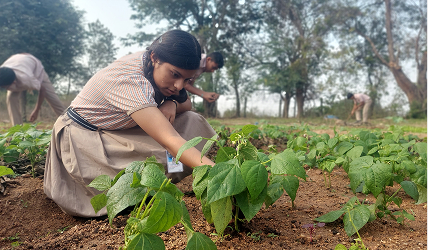
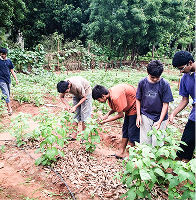
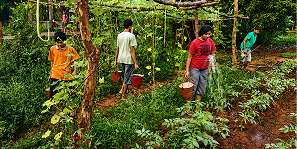
Soil, biodiversity, water, organic farming, and ecological observation. Students cultivate plots, conduct experiments, and maintain farm journals.
All FIEK school programmes are built on the Living Classroom Framework and delivered across four partnership tiers. Choose the depth that suits your institution. Every programme is available across four levels of commitment — from a single introductory session to a full academic-year partnership. (Full detail under Partnership Models, below.)
Soil, biodiversity, water, organic farming, and ecological observation. Students cultivate plots, conduct experiments, and maintain farm journals.
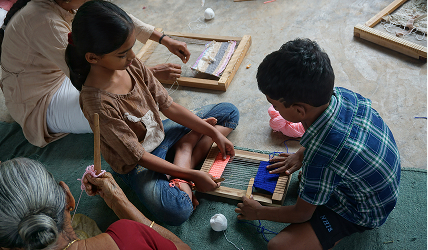
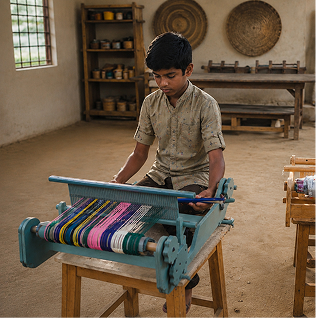
From seed to fabric: desi cotton farming, hand-spinning, natural dyeing, and weaving. Students explore fibre science, chemistry, geometry, maths
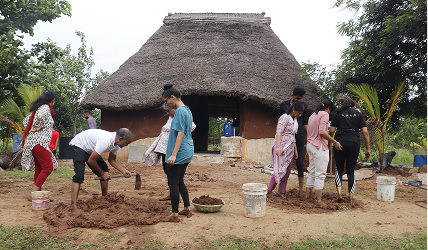
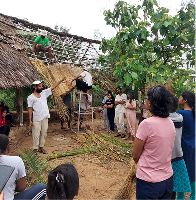
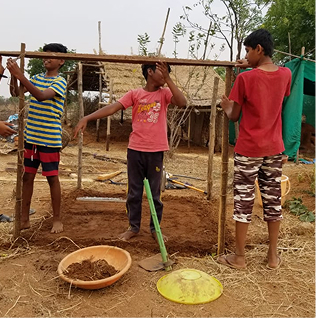
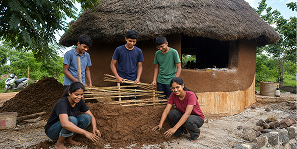
Earthen construction, bamboo structures, lime masonry, and thatching. Students learn structural physics, material science, climate-responsive design, and indigenous architectural heritage.
Why Partner With US
Today's schools are preparing students for a future that demands far more than academic achievement alone.
These capabilities emerge most powerfully when knowledge is experienced rather than simply memorised. Schools increasingly recognise this shift. The challenge is not whether experiential learning should become part of education. The challenge is implementing it in ways that are academically meaningful, curriculum-linked and sustainable over time.
That is where FIEK becomes a partner.
All FIEK school programmes are built on the Living Classroom Framework and delivered across four partnership tiers. Choose the depth that suits your institution. Every programme is available across four levels of commitment — from a single introductory session to a full academic-year partnership. (Full detail under Partnership Models, below.)
Students who go through FIEK's programmes develop critical thinking, observation skills, scientific inquiry, collaboration and environmental literacy not instead of academic learning, but through it. A student measuring a garden plot is doing maths. A student testing soil pH is doing chemistry. A student weaving a wall is doing physics.
Our facilitators model interdisciplinary lesson planning and outdoor classroom management. Teachers gain practical tools for connecting curriculum to real-world application, tools they can use long after FIEK's direct engagement ends.
NEP 2020 compliance. Differentiated positioning. Measurable parent satisfaction. A visible commitment to sustainability that strengthens admissions and community trust.
The National Education Policy 2020 explicitly calls for experiential learning, activity-based education, vocational exposure, environmental literacy, and multidisciplinary, inquiry-based learning. FIEK's programmes are built directly against these requirements not retrofitted to claim alignment after the fact. Every programme is curriculum-linked, aligned with board requirements, and designed to complement existing classroom teaching while respecting academic calendars and examination schedules. Schools can implement FIEK programmes seamlessly without disrupting their core curriculum.

Every session is hands-on by design, not supplemented with an activity.

Oasis School of Excellence has introduced Agriculture as a formal vocational subject for Grades 5-10 through this partnership.

composting, water conservation and organic farming are taught as practice, not as a unit.

Educational experiences are strengthened through field documentation, research collaborations and continuous learning from living knowledge systems.
Measurable increase in student engagement and teamwork, reported consistently across partner schools
Agriculture introduced as formal vocational subject, Grades 5-10.
Students produce 90% of campus kitchen vegetables through the year-long farm programme.
5-acre degraded plot restored into a permaculture learning classroom with 1,400 trees across 26 species.
Elementary students constructed earthen structures and mastered seed-ball propagation.
Developed over three years of continuous work, the Living Classroom Framework structures every programme around Nature, Food, Shelter and Materials the four relationships that shape daily life. It gives teachers and school leadership a coherent pedagogical story to point to, not a collection of unrelated tips.
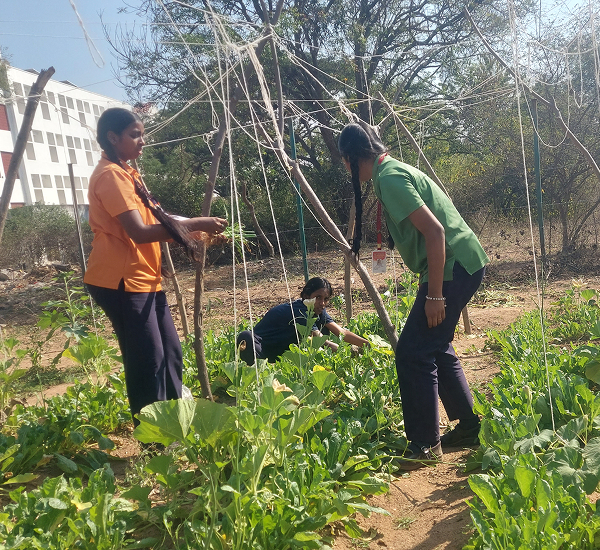
Nature as Classroom turns a school kitchen garden into a working laboratory. Across four phases: Orientation & Sensory Learning, Ground Preparation & Planting, Growth Monitoring, and Harvest & Reflection students run an organic garden from seed to harvest, with FIEK facilitators on campus on those days.
1-3 sessions/week during vocational periods · Grades 5-10
Maths (plot area, yield), physics (simple machines, composting energy), biology (plant cycles, pest control), chemistry (soil pH, decomposition), geography (soil mapping) and economics (budgeting, market simulation).
A dedicated land patch, water access, scheduled class time, and basic tools and seeds.
Download Details Brochure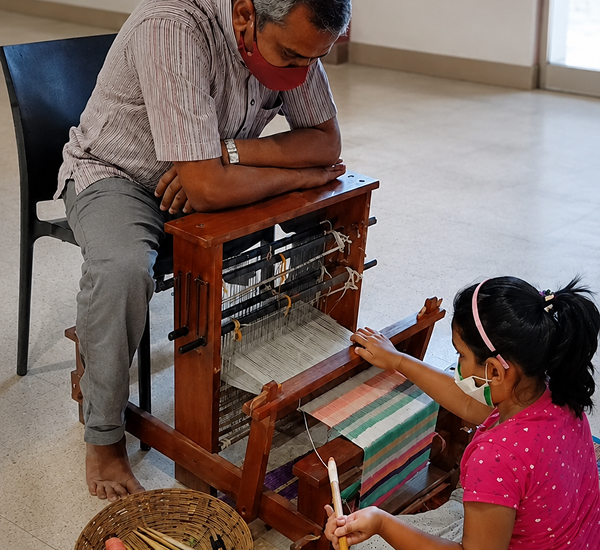
Students trace a garment's entire journey from raw desi cotton to finished cloth through six stages: hands-on seed separation, spinning on a charkha, natural dyeing with plant extracts, weaving on a loom, and dyeing the cloth they have woven.
School campus or open space · Grades 5-10 · 30-40 students per batch
science (fibre structure, natural dyes), social studies (rural livelihoods, the freedom movement), art (colour, pattern), and environmental education (production impact).
An open, ventilated space, water and basic electricity access, tables for dyeing, and AV setup for the film.
Download Details Brochure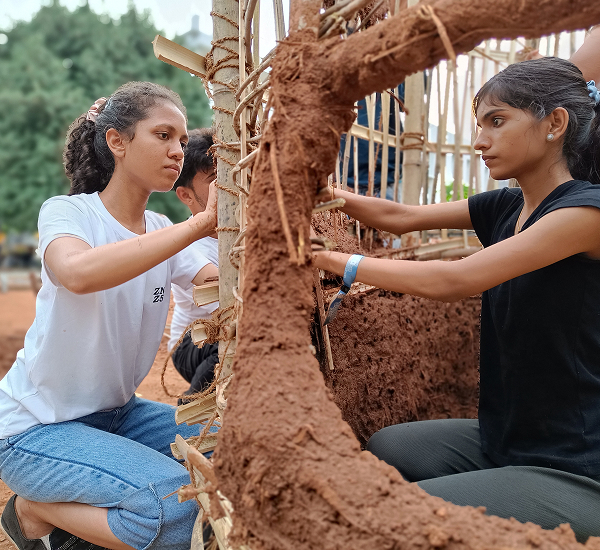
Students explore traditional construction earth, stone, bamboo, thatch and lime through storytelling, a photo exhibition of vernacular architecture, hands-on soil science (clay, silt, sand), a live lime-slaking demonstration, and a culminating team build: each group constructs a miniature shelter model, or collaborates on a full-scale earthen structure.
Open outdoor space · Grades 5-10 · 40-60 students per session
structural and material science (load, compression, tension), teamwork and spatial reasoning, and a direct experience of India's vernacular building traditions.
Download Details Brochure"The first time we made compost in school, it smelled. Everyone laughed. Even me. But when the first brinjal came from that soil, I didn't let anyone touch it. I carried it home in my shirt. My mother cooked it with extra oil. My father said it tasted different. I told him, 'That is because it came from our hands."


"Every farming session felt like an adventure. Instead of memorising lessons, we discovered things ourselves. I started noticing birds, insects and different kinds of plants everywhere, even near my home."

"The hands-on approach has sparked curiosity and a genuine love for nature. Parents have shared how their children now talk about composting and gardening at home."

"I expected my son to learn about sustainability. I didn't expect him to change our family's habits. We now compost our kitchen waste because he insisted. He even explained the science behind it to us. Children influence families more than we realise."

"Partnering with Mayank and his team has brought invaluable hands-on experiences in organic farming, composting, and nursery development. We are nurturing a generation of environmentally conscious young farmers."
"The experience transformed the way I see nature and my relationship with the Earth. I returned home carrying real knowledge, not a renewed sense of responsibility."
"The experience transformed the way I see nature and my relationship with the Earth. I returned home carrying real knowledge, not a renewed sense of responsibility."
"The experience transformed the way I see nature and my relationship with the Earth. I returned home carrying real knowledge, not a renewed sense of responsibility."
"The experience transformed the way I see nature and my relationship with the Earth. I returned home carrying real knowledge, not a renewed sense of responsibility."
"The experience transformed the way I see nature and my relationship with the Earth. I returned home carrying real knowledge, not a renewed sense of responsibility."
Every school starts somewhere different. This is the same ladder, regardless of which programme you choose.
 2-3 hours
 Interactive demonstrations and hands-on activities
 Ideal for: School assemblies, orientation events
 1-3 days
 Deep experiential exploration, reflection, and collaboration
Ideal for: Thematic learning days, field trips
 1-3 days10-15 sessions
Structured learning journey with projects and skill development
Ideal for: Clubs, electives, vocational modules
 Full academic year
Integrated curriculum, exhibitions, teacher collaboration, and campus-based initiatives
Ideal for: School experiential curriculum transformation
Tell us about your school, grade levels, campus space, and what you're hoping to achieve. We will design a programme that fits your context.